This is the manual version. Start Pocket Agent if you want the system to run for you.
Wire the Brain to Your Stack
Drive, Gmail, Slack, Notion, Linear, GitHub, Supabase — wired in, gotchas named, working queries you can copy and run.
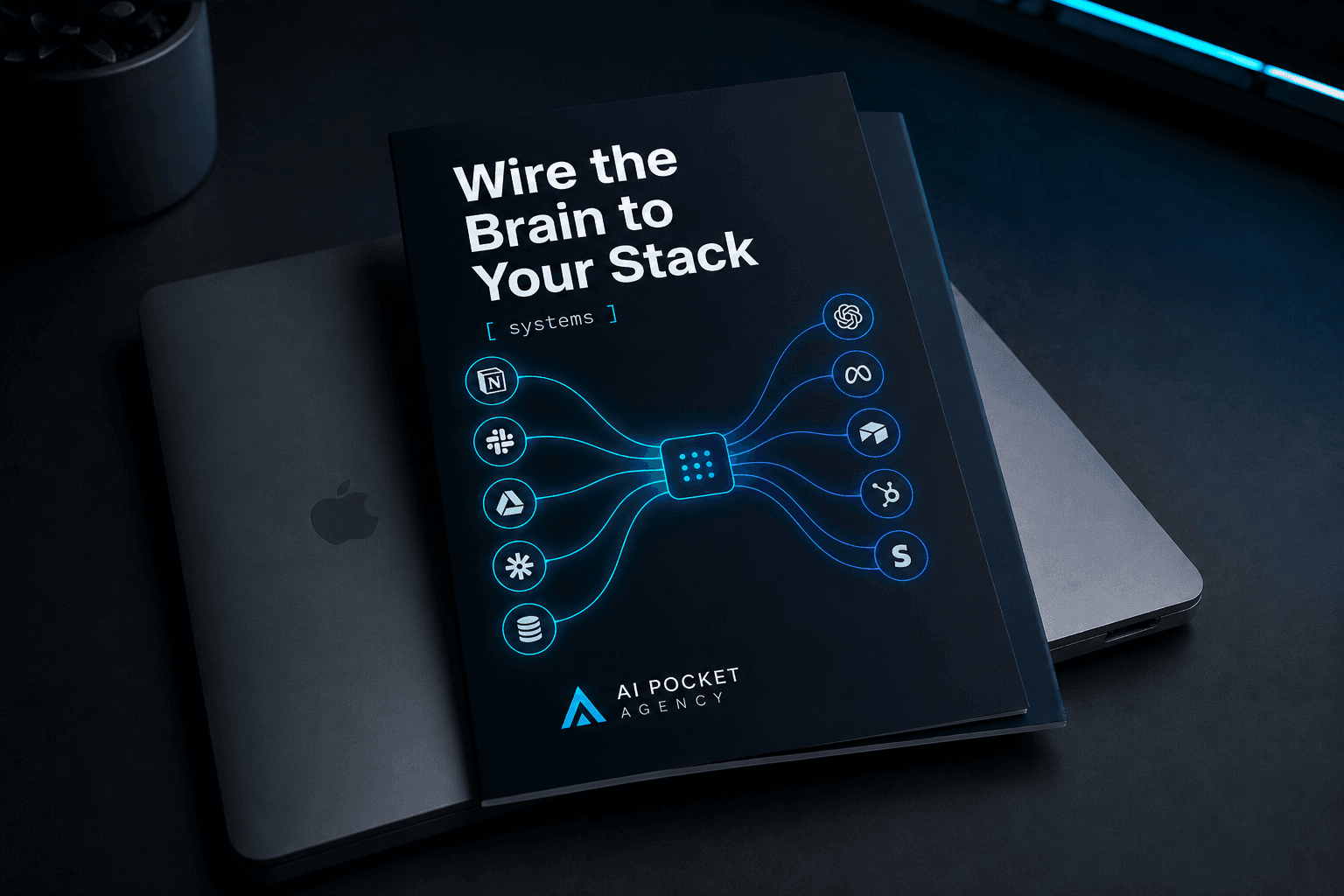
The brain works alone. It multiplies when you wire it to the tools you actually use.
Most people with a brain set up never wire it to anything. The docs are scattered. The OAuth flows are confusing. Every connection has three scope decisions that read identical until one of them locks you out at runtime.
So the brain sits there — useful for context, useless for action. The Gmail thread the buyer cited stays buried. The Drive folder with the spec stays unread. The Linear ticket gets opened by hand. Every time.
The unlock isn't a smarter brain. The unlock is wiring it to the seven places your work already lives.
Seven walkthroughs. Same shape every time.
Each walkthrough covers four things: the auth flow with the exact scopes you actually need, three working example queries you can copy and run, three gotchas that trip people on their first wire-up, and one sync pattern that turns the connection into a brain multiplier instead of a read-only lookup.
- 1Drive MCP — OAuth + Google Cloud project setup, `drive.readonly` + `drive.metadata` scopes, the shared-drive vs my-drive trap, sync pattern: Drive changelog → brain Decision Log entry
- 2Gmail MCP — OAuth, `gmail.readonly` + `gmail.modify` scopes, the message-vs-thread ID gotcha, sync pattern: Gmail label → brain task entry
- 3Slack MCP — workspace OAuth, bot-vs-user token decision, private-channel access trap, sync pattern: decision message → brain Decision Log with link back to the thread
- 4Notion MCP — integration token + per-page invites, block-vs-page model trap, sync pattern: brain changelog → Notion database
- 5Linear MCP — API key vs OAuth, team-vs-project scope, label conventions, sync pattern: Linear ticket → brain task; brain task closure → Linear issue close
- 6GitHub MCP — PAT vs GitHub App OAuth (when to use which), the install-per-repo gotcha, sync pattern: commits + PR descriptions → brain Change Log entries
- 7Supabase MCP — access token + project scope, RLS-aware query patterns, service-role-vs-anon-key gotcha, sync pattern: schema → brain Feature Inventory sync
PDF guide + 7 markdown walkthroughs + a sanitized screenshot library from the auth flows I actually ran. Every screenshot is from a real setup. Every gotcha is one I hit before I wrote it down.
The rest of the stack.
Each kit is $15. Same shape, same instant download, same refund-on-reply guarantee.
- [ $15 · instant download ]The Dispatch Playbook
The field manual for running parallel Claude Code agents without them stepping on each other.
Get it for $15 - [ $15 · instant download ]The Dev-Team Document Set
Eleven document templates plus three operational conventions — drop them into any repo and the agents inherit dev-team discipline on day one.
Get it for $15 - [ $15 · instant download ]The CLAUDE.md Template Library
Six opinionated CLAUDE.md templates (SaaS, contractor SaaS, marketing site, mobile app, API service, internal tool) — pick the closest, fill five slots, agent is on-rails in thirty minutes.
Get it for $15 - [ $15 · instant download ]Discovery → MVP Prompt Pack
The sequenced prompts I use to turn a 30-minute discovery call into shipped software in days. Eight prompts. One real case study — Patrick, end to end.
Get it for $15
Want all five? Bundle for $60 — save $15 against $75 buying them separately.
Five $15 playbooks = $75. All five bundled together — Dispatch, Dev-Team Document Set, CLAUDE.md Template Library, Discovery → MVP Prompt Pack, Wire-the-Brain-to-Stack — at $60.
Your Pocket Agent gets sharper every week.
This playbook is one piece. Pocket Agent captures everything your AI needs and gives back — standup before coffee, brief before every call, customer Q&A in your voice. Pocket Agent gets sharper every week. You don't lift a finger.
Tap once. Your AI captures the rest.
Voice memos, screenshots, share links, emails, Loom recordings — all filed automatically. Nothing dies in your head.
Your AI works while you sleep.
Standup before coffee. Brief before every call. Customer Q&A in your voice. Content from past wins. It just runs.
Want this running without the setup?
The playbook teaches the pattern. Pocket Agent runs it — every playbook active from day one. Sign up and you're running.
You can buy this kit and build the workflow yourself.
Or start Pocket Agent and have your AI run the workflow for you.
[ $97/mo · 14-day free trial · Skool community included ]
$15. Instant download. Wire two integrations this weekend, the other five over the year.
$15. Instant download. PDF + 7 markdown files + screenshot library — the lot lands in your inbox the moment Stripe confirms.
If you wire one MCP from this guide and it doesn't return a working query against your real data, reply and I'll refund it. No form, no question.